
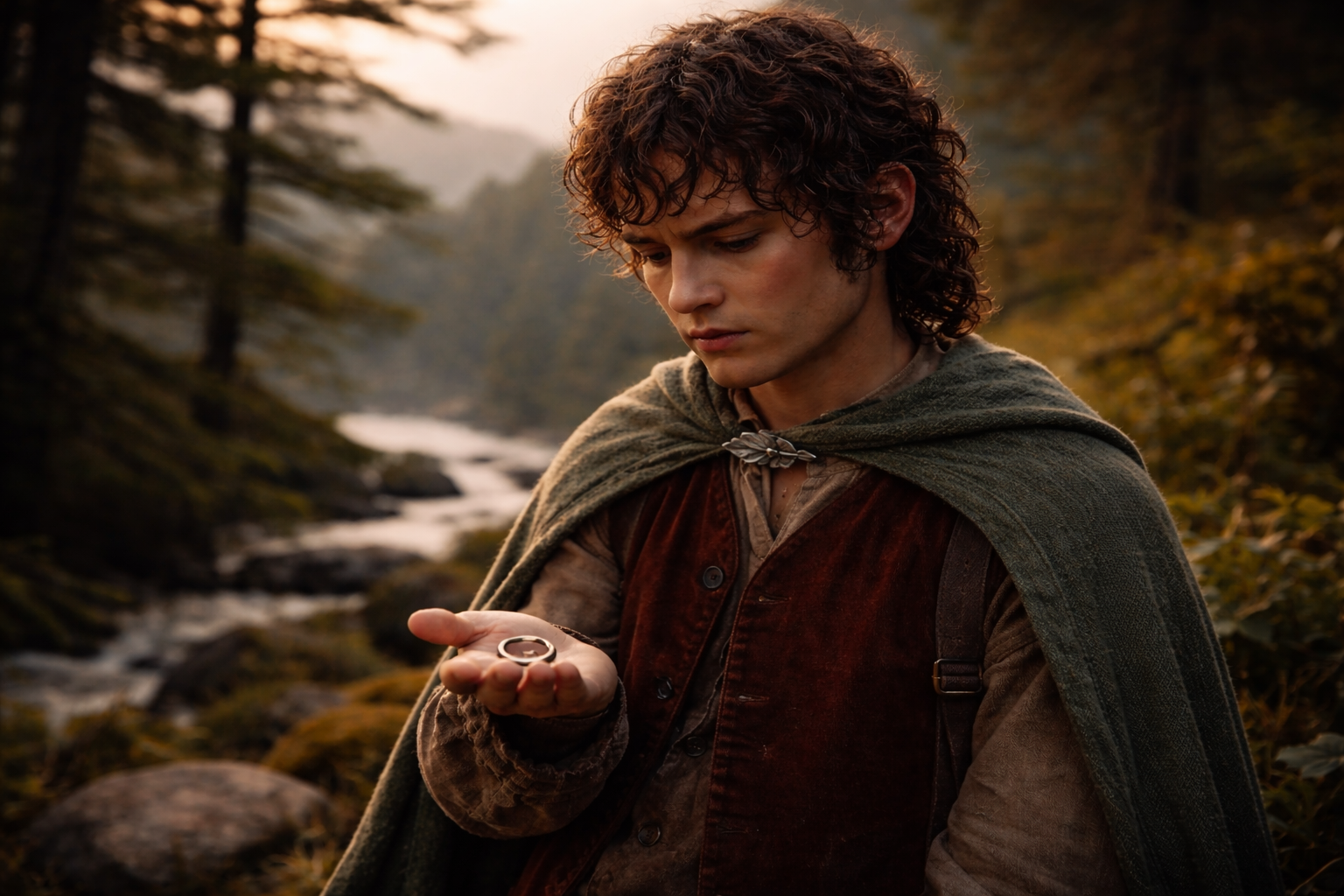
When people think of heroes in literature, they often imagine figures like Aragorn or Achilles—warriors with great power, dazzling victories, and legendary fame. Yet J.R.R. Tolkien’s The Lord of the Rings reminds us that true heroism often comes in quiet, humble forms. At the heart of Middle-earth is Frodo Baggins, an ordinary hobbit whose journey proves that courage, selflessness, and perseverance define a hero far more than a sword ever could.
The Burden of the Unseen: Why Frodo is the Ultimate Reluctant Hero
Frodo’s story is unique because his greatest achievements are largely invisible. While his companions—Merry and Pippin—are celebrated as knights of Rohan and Gondor, Frodo carries the heaviest burden: the One Ring.
The Ring is not merely a weapon; it is a psychological mirror reflecting one’s darkest desires. Unlike Boromir, who succumbed to the temptation of power, Frodo’s heroism lies in his resistance. For months, he endured the mental assault of Sauron. This “invisible warfare” is a powerful metaphor for modern struggles with mental health or ethical dilemmas where the hardest battles are fought internally, without an audience.
The Ethics of Failure: Heroism Beyond Perfection
One of the most profound lessons from Frodo is that heroism does not require perfection. In the final moments at the Cracks of Doom, Frodo ultimately claims the Ring for himself. He “fails” his mission in the literal sense.
However, Tolkien argues that Frodo is still a hero because of his intent and the effort he expended to get there. His failure highlights a crucial SEO-relevant theme: The limits of human (or hobbit) will. It teaches us that we can be heroic even if we stumble at the finish line, provided we had the courage to walk the road. It was Frodo’s earlier act of mercy toward Gollum—a small, quiet choice—that ultimately saved Middle-earth when his own strength failed.
Sacrifice Without Reward: The Scars of Mount Doom
Frodo’s journey highlights the harsh reality of sacrifice. Unlike a Hollywood ending where the hero gets the crown, Frodo’s story ends with a bittersweet departure. He carries physical and psychological scars—the wound from the Witch-king’s blade and the trauma of the Ring—that prevent him from ever truly returning to his old life.
In today’s “hustle culture,” we are often told that hard work leads to external rewards. Frodo reminds us that:
- True sacrifice means giving up something for a cause, even if you don’t get to enjoy the victory.
- Post-traumatic growth is real, but it changes you permanently.
- Quiet courage often goes unthanked by the masses who benefit from it.
The Power of Interdependence: Frodo and Samwise Gamgee
You cannot discuss Frodo’s heroism without Samwise Gamgee. Their relationship is the emotional core of the trilogy. Tolkien’s work underscores that great deeds rarely occur in isolation.
While Frodo carried the Ring, Sam carried the Ring-bearer. This partnership illustrates a vital life lesson: True strength is knowing when to lean on others. In a world that prizes “self-made” success, the bond between Frodo and Sam stands as a testament to the fact that empathy and loyalty are the fuels that keep courage burning in the darkest places.
Why Frodo’s “Smallness” Matters in a Big World
Tolkien, a veteran of WWI, saw firsthand that the world isn’t changed only by generals, but by the “small” people doing their duty. Frodo represents the “Everyman.” He has no magic powers and no military training.
By choosing a Hobbit as the savior of the world, Tolkien sends a clear message: Your stature does not determine your impact. Whether you are a student, a worker, or a parent, your “small” acts of integrity—choosing honesty over a shortcut, or kindness over cynicism—are the ripples that change the tide of the world.
Conclusion: Living the Lessons of the Shire
In a digital age that emphasizes visibility, fame, and public recognition, Frodo’s story is a timeless counterpoint. He embodies a kind of heroism rooted in resilience and moral integrity.
Frodo Baggins teaches us that:
- Heroism is a choice, made daily in the face of exhaustion.
- Humility is a shield against the corrupting influence of power.
- Quiet deeds are often the most transformative.
Ultimately, we are all Ring-bearers in our own way, carrying burdens others cannot see. If we can emulate Frodo’s steadfastness and Sam’s loyalty, we find that even the smallest person can indeed change the course of the future.
Read more here about: Why Less Work, More Reserves, and Strong Communities Create a Good Life