
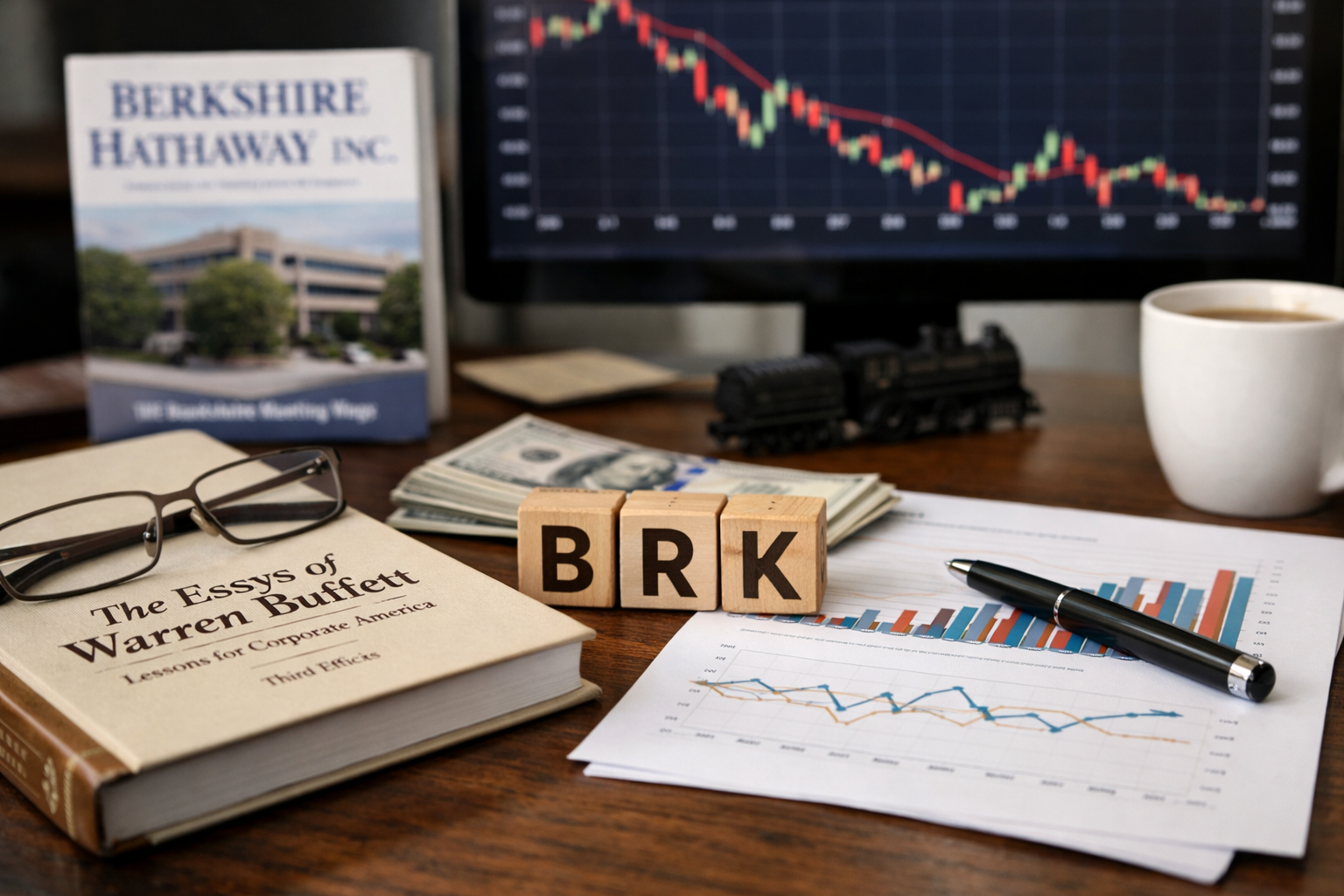
When Berkshire Hathaway (BRK.B) shares dip 5% following a quarterly earnings report, the financial headlines often turn reactionary. Short-term drawdowns trigger a familiar cycle of questions: Is the growth engine slowing down? How will the leadership transition impact the culture? Is the massive cash pile a drag on returns?
However, for the seasoned “value” or “tech-adjacent” investor, a single trading session is merely noise. To understand why Berkshire remains a cornerstone of long-term portfolios, we must look past the ticker symbol and analyze the underlying mechanics of its compounding engine. Specifically, we need to focus on two fundamental pillars: Book Value growth and Operating Earnings.
1. The Anatomy of a Pullback: Context vs. Catalyst
In the world of computer science, we often talk about “signal vs. noise.” In investing, a 5% pullback is frequently noise. Market reactions to earnings are often driven by algorithmic trading or institutional rebalancing rather than a fundamental shift in the company’s “source code.”
For Berkshire, a pullback often occurs because the market expected a massive acquisition (“the elephant gun”) that didn’t happen, or because unrealized losses in the massive equity portfolio (like Apple or American Express) skewed the GAAP net income. To see the “signal,” we must look at the Intrinsic Value.
2. Why Book Value is the “Source Code” of Berkshire
For decades, Warren Buffett pointed to the growth in Book Value per Share (BVPS) as the primary yardstick for Berkshire’s success. While the company has evolved into a complex conglomerate—making book value a conservative estimate—it remains a vital metric for tracking capital compounding.
What is Book Value in a Modern Context?
Think of Book Value as the “version history” of Berkshire’s equity. It represents:
- Retained Earnings: The cumulative profits from subsidiaries like GEICO or BNSF.
- The Investment Portfolio: The marked-to-market value of public holdings.
- Capital Reserves: The “dry powder” held for future deployment.
Because Berkshire pays no dividend, 100% of its earnings are retained. This makes BVPS a direct reflection of management’s ability to reinvest capital effectively. In recent years, Berkshire has maintained a steady high single-digit to low double-digit growth rate in book value. For a company of its size, this is the financial equivalent of a legacy system that continues to scale without breaking.
3. Operating Earnings: The Execution Layer
While the media loves to report on Berkshire’s “Net Income,” savvy investors focus on Operating Earnings. Net income includes the fluctuating prices of the stocks Berkshire owns—volatility that doesn’t reflect the daily health of the businesses.
The Four Pillars of Berkshire’s Operations:
- Insurance (The Float): GEICO and Berkshire Hathaway Reinsurance provide “float”—capital that Berkshire holds before claims are paid. This is effectively interest-free leverage.
- BNSF Railway: A critical piece of American infrastructure. It’s a “wide-moat” business that generates consistent cash flow regardless of tech cycles.
- Energy (BHE): A long-term play on the transition to renewables and grid stability.
- Manufacturing & Retail: A diverse array of companies (from Precision Castparts to See’s Candies) that provide a steady stream of non-correlated income.
When these core businesses show growth, the “engine” is working. A quarterly dip in operating profit due to a hurricane (impacting insurance) or lower rail volumes is usually a temporary bug, not a systemic crash.
4. The “Cash Problem” is Actually a Strategic Buffer
One of the most frequent criticisms is Berkshire’s massive cash position, which recently soared past $180 billion. Critics call it “dead capital.”
However, in an era of high valuations and economic uncertainty, this cash is strategic optionality. Berkshire acts as the “Lender of Last Resort.” During the 2008 financial crisis and subsequent market dislocations, Berkshire was able to deploy capital into high-yielding deals that were unavailable to anyone else. For the long-term investor, this cash is an insurance policy against market volatility and a war chest for the next “Black Swan” event.
5. Is a 5% Pullback a Buying Opportunity?
To determine if a dip is a “buy the dip” moment, we must ask four structural questions:
- Is BVPS still trending upward over a 3-year rolling average? (Yes)
- Are the core operating subsidiaries maintaining their competitive moats? (Yes)
- Is capital being allocated rationally (e.g., through strategic share buybacks)? (Yes)
- Is the balance sheet “Fortress-level” strong? (Unquestionably)
If the answer to these is yes, a 5% decline is often just the market offering a slight discount on a premium asset.
6. The Long-Term Verdict: The Power of Compounding
Berkshire Hathaway is no longer a high-growth “tech-style” disruptor. Instead, it is a resilient compounding platform. It functions like a self-sustaining ecosystem:
- Subsidiaries generate Cash.
- Insurance provides Low-cost Capital.
- Management Reinvests that capital into high-quality assets.
- Retained Earnings drive the Book Value higher.
For an investor with a 10- or 20-year horizon, this cycle is incredibly powerful. Even an 8–10% annual growth rate, when compounded without the “leakage” of dividend taxes at the corporate level, creates massive wealth.
Final Thoughts
A 5% pullback is a reminder that even the most stable companies are subject to market gravity. But for Berkshire Hathaway, the fundamental investment thesis—built on diversified operating strength and disciplined capital allocation—remains unchanged.
In the words of Charlie Munger, “The first rule of compounding is to never interrupt it unnecessarily.” A short-term market fluctuation is the ultimate test of that rule. If the pillars of book value and operating growth are standing, the foundation is solid.